

Sensory Rooms: The Complete Guide to Planning, Building, and Funding One
GET YOUR
CUSTOM QUOTE
Sensory rooms typically cost between $5,000 and $50,000, and many are built without construction using portable interactive projection systems such as EyeClick's BEAM, which starts at $5,796 and installs in under 2 hours.
What is a sensory room?
A sensory room is a dedicated space fitted with equipment that lets users control the sensory input they receive: light, sound, touch, movement, and sometimes smell. The same room can help an overstimulated student calm down, draw a withdrawn memory care resident into engagement, or give a therapy client a safe, motivating place to work on motor and social goals.
The idea is not new. Multi-sensory environments grew out of an approach developed in Dutch care settings in the 1970s, often called Snoezelen, which paired gentle sensory stimulation with an unhurried, user-led atmosphere. What began in disability care has since spread to schools, hospitals, senior living communities, libraries, churches, airports, and family entertainment venues.
A well-planned sensory room is not a pile of equipment. It is a controlled environment with a purpose: every light, surface, sound, and activity is chosen to calm, alert, or engage a specific group of users.
Sensory room, multi-sensory environment, or sensory space?
These 3 terms describe the same core idea at different levels of formality:
- Sensory room is the everyday term: a dedicated room equipped for sensory regulation, stimulation, or therapy.
- Multi-sensory environment (MSE) is the term used in clinical and research literature. It usually implies a deliberately designed space addressing several senses at once, often with a control system so a therapist or user can adjust the inputs.
- Sensory space (or sensory corner) is the informal version: a corner of a classroom, library, or waiting area with a few well-chosen elements. Many organizations start here and grow into a full room.
Who uses sensory rooms?
Sensory rooms started in disability and special education settings, but adoption has widened steadily. The common thread: any place serving people who need help regulating sensory input, or who benefit from sensory-rich engagement.
Schools and special education programs
Schools are among the most common adopters. Sensory rooms support students with autism, ADHD, sensory processing differences, and anxiety, giving them a structured place to regulate before returning to class. Many districts also use them proactively: scheduled sensory breaks rather than crisis response. Special education departments typically lead the project, but well-run rooms serve the whole student body.
Pediatric therapy clinics
Occupational, physical, and speech therapy clinics use sensory rooms as working treatment spaces. Equipment here tends to be more clinical: swings and suspension systems, climbing and crash equipment, and activities a therapist can grade up or down to match each child's goals. The room is a tool inside a treatment plan, not a free-play area.
Senior care and memory care communities
In assisted living and memory care, sensory rooms serve a different goal: engagement and connection rather than calming alone. Multi-sensory stimulation is used with residents living with dementia to spark responses that conversation sometimes cannot, and group sensory activities give life-enrichment teams a reliable programming option for residents at very different cognitive levels.
Hospitals and healthcare facilities
Hospitals add sensory rooms in pediatric units, behavioral health units, and emergency departments. In behavioral health settings, some facilities report using sensory rooms as part of efforts to de-escalate distress and reduce reliance on more restrictive interventions.
Libraries, museums, and other public spaces
Public libraries increasingly pair sensory-friendly hours with a dedicated sensory space, and museums and airports have followed with quiet rooms for overstimulated visitors. These rooms prioritize durability, easy supervision, and self-explanatory equipment, since staff cannot run every session.
Churches and community organizations
Churches and community centers build sensory rooms so families of children with disabilities can actually attend services and programs. A sensory room next to the children's ministry area is one of the most concrete inclusion investments a congregation can make.
Family entertainment centers and play venues
FECs, trampoline parks, and indoor playgrounds are adding sensory rooms for 2 reasons: a quiet retreat for guests who get overwhelmed, and sensory-friendly sessions that open the venue to families who would otherwise stay home.
What does the research say about sensory rooms?
The honest answer: research suggests meaningful benefits in several settings, but the evidence base is uneven, and a sensory room is a tool, not a treatment by itself. Here is where the evidence currently stands, stated carefully:
- Dementia and senior care. Systematic reviews of multi-sensory stimulation in dementia care report promising effects on mood, engagement, and agitation during and immediately after sessions, though study quality varies and long-term effects are less clear. Practitioners widely value MSEs as a nonpharmacological engagement option.
- Behavioral health. Studies in psychiatric inpatient units have reported reduced self-rated distress after sensory room use, and some facilities have reported lower use of seclusion and restraint after introducing sensory approaches. Results differ between facilities, and implementation quality appears to matter as much as the room itself.
- Schools and autism. Evidence here is mostly small studies and practitioner reports. They commonly describe improved self-regulation, smoother transitions, and fewer escalations when sensory breaks are structured and staff are trained. Formal research on sensory integration therapy shows mixed results, which is a reason to frame a school sensory room as a regulation and access support rather than a clinical intervention.
3 practical takeaways from the research: train the staff who will use the room, define what the room is for before buying anything, and track simple outcome measures (incident counts, time-to-calm, participation rates) so you can show your own results.
Design principles by population
A sensory room for a memory care unit and a sensory room for a kindergarten share equipment categories but almost nothing else. Design for the people who will actually use the room. For ready-made layouts by space, budget, and population, see our sensory room ideas guide.
For autism and special education
Predictability and user control matter most. Aim for:
- Zoning. Separate a calming zone (dim, enclosed, soft) from an active zone (movement, interactive play). A single undifferentiated room full of stimulation works against regulation.
- Controllable input. Dimmable lighting, volume control, and equipment that responds to the user. Being able to change the environment is itself regulating.
- Low sensory baseline. Neutral walls, minimal visual clutter, sound dampening. Add stimulation deliberately instead of fighting a noisy room.
- Safety without an institutional feel. Padded flooring, rounded corners, secure mounting, no small detachable parts.
- Clear routines. Visual schedules, timers, and consistent entry and exit rituals. The room should never be used as a punishment or a reward; it is a regulation support.
For pediatric therapy clinics
Therapists need adjustability. Choose equipment that can be graded across ability levels, leave open floor area for gross-motor work, and favor activities that generate measurable responses a therapist can tie to goals. Storage matters more than it sounds: a working clinic room changes configuration several times a day.
For senior care and memory care
Design around aging senses and fall risk:
- High visual contrast and even, glare-free lighting, since aging eyes need more light and handle glare poorly.
- Seated-access equipment, stable furniture that supports transfers, and clear circulation paths for walkers and wheelchairs.
- Avoid dark floor surfaces and high-contrast floor patterns in walking paths; in dementia care design, dark areas on the floor are commonly reported to be perceived as holes.
- Favor familiar, reminiscence-friendly content (nature scenes, music of residents' generations) over abstract stimulation.
- Keep operation simple enough that any activity aide can run a session without a manual.
For libraries, churches, FECs, and other public spaces
Public rooms must work without a trained operator. Prioritize equipment that is intuitive, durable, and cleanable; avoid anything with loose parts; design sightlines so 1 staff member can supervise; and post simple visual rules. For commercial venues, hygiene is a real constraint: surfaces and equipment get heavy mixed-age use, which is one reason no-touch, motion-based activities have become popular in these settings.
Sensory room equipment: the main categories
Most sensory room equipment falls into 7 categories. The right mix depends on your population and purpose; almost no room needs all of them. For a deeper, product-level breakdown with selection criteria, see our sensory room equipment guide.
- Visual: bubble tubes, fiber optic strands, color-changing LED panels, passive projection effects (slow-moving lights and patterns). The backbone of most calming zones.
- Auditory: sound systems, white noise, nature soundscapes, music selection controls, and sound-dampening treatment for the room itself.
- Tactile: texture panels and walls, weighted lap pads and blankets, fidget collections, and varied-surface flooring.
- Proprioceptive and vestibular: therapy swings, crash pads, rocker boards, climbing elements. These deliver the deep pressure and movement input many users need most, and they require the most safety planning.
- Olfactory: aroma diffusion, used sparingly and with allergy and sensitivity policies in place.
- Control systems: switches, dimmers, and tablets that let a user or therapist change the room. Control is not an accessory; it is often the point.
- Interactive technology: motion-responsive floors, walls, and tables that turn movement into immediate visual and audio feedback. This is the category that adds active, whole-body engagement, and it is the one most rooms are still missing.
The gap in most sensory rooms: active, gross-motor play
Walk through most sensory room catalogs and installed rooms and you will notice a pattern: nearly everything is passive or seated. Bubble tubes, fiber optics, and tactile panels are genuinely valuable, but they engage users who are sitting still and watching. Movement, the input many children and adults seek hardest, is often limited to a single swing.
That is a design gap, because gross-motor activity is itself sensory input. Occupational therapy practice distinguishes between calming input (slow, rhythmic, deep pressure) and alerting input (movement, novelty, responsive feedback), and a room that only calms serves only half the need. Active play also gives users who will not engage with quiet equipment, often the very users the room was built for, a way in.
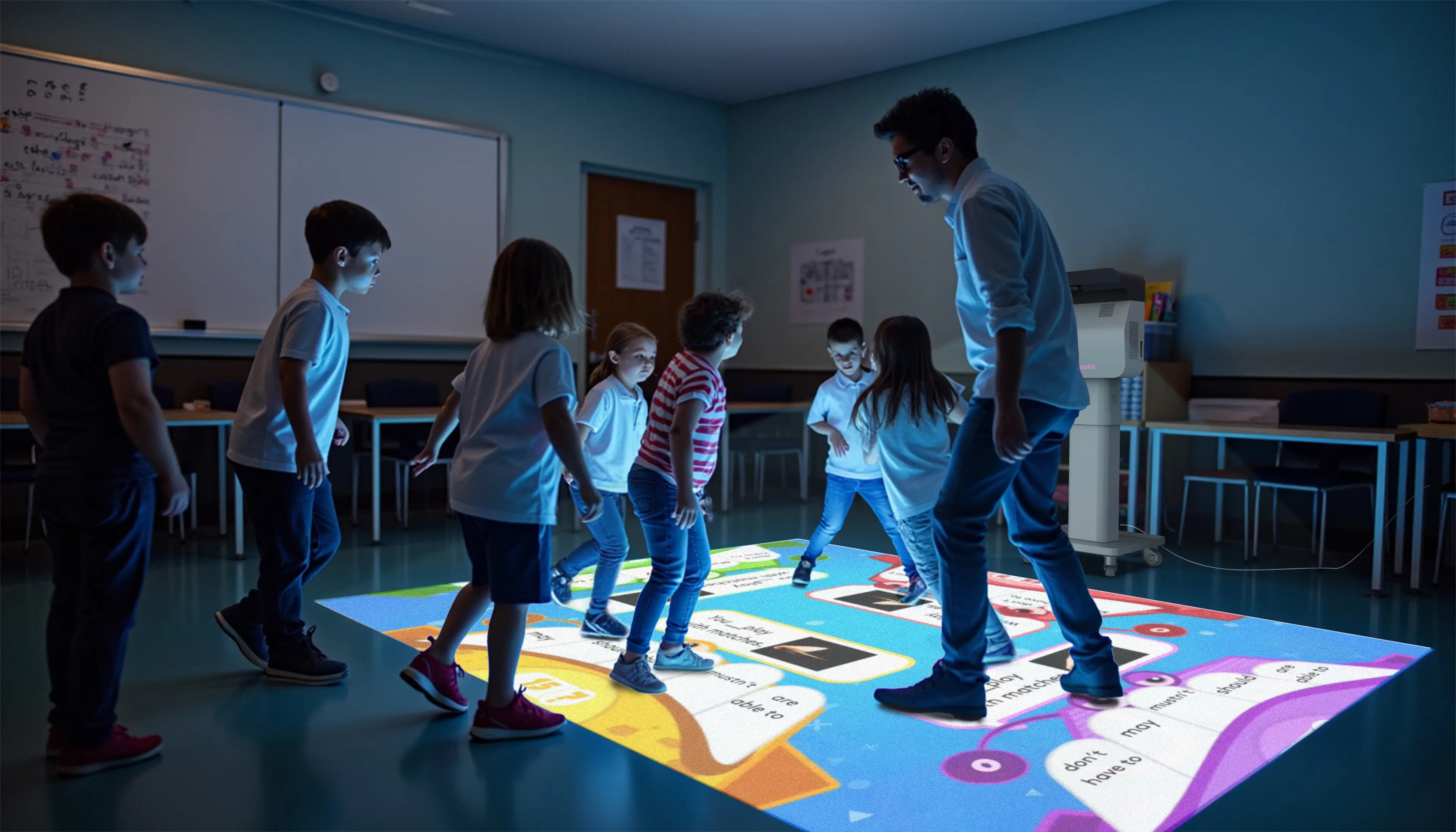
Interactive projection fills this gap. A motion-sensor projector turns an ordinary floor, wall, or table into a responsive play surface: step on a virtual pond and it ripples, wave at falling shapes and they scatter. There is nothing to hold, wear, or touch, which keeps the activity hygienic and accessible to users with very different motor abilities, and the cause-and-effect feedback is immediate, which is exactly what holds attention in a sensory context.
This is the component EyeClick builds. BEAM is a portable interactive projector that works on floors, walls, and tables, installs in under 2 hours with no construction, and is published from $5,796, which puts an active-play anchor within reach of even a starter budget. Obie is the classroom-focused version used in education settings. Content libraries are built per audience: 350+ games for play and entertainment settings, 100+ games designed for senior care, and thousands of learning activities built from templates on the EyeWiz education platform. Across 20 years, these systems have been installed in thousands of schools, hundreds of therapy clinics, and 3,000+ entertainment venues.
To be clear about the role: an interactive floor or wall is one component of a sensory room, not the whole room. It belongs in the active zone, alongside, not instead of, the calming equipment above. If you are comparing projection options for the active zone, our interactive floor projector guide covers the technology in depth, and our best interactive floor projectors buyer's guide compares vendors on no-touch motion, sensory-appropriate content, and the other criteria that matter for special-education rooms. For a classroom-focused sensory or active-learning space, see our best interactive projectors for classrooms comparison; for senior living and memory care rooms, our guide to comparing interactive activity systems for senior care covers the options designed for older adults.
If the active zone is a wall rather than a floor, our interactive wall projector guide covers wall games for sensory rooms, and the projector games library can be browsed by surface.
Space and budget planning
You need less space than you might think, and budgets cluster into 3 realistic tiers. Most sensory room projects land between $5,000 and $50,000 depending on scope.
Space requirements. A usable sensory corner starts at roughly 8 x 10 feet. A dedicated room works well from about 150 square feet, and 250 to 400 square feet comfortably supports separate calm and active zones. Beyond size, check 4 things early: the ability to dim or black out light, standard power outlets where equipment will live, ventilation, and ceiling mounting requirements for any projection or suspension equipment (verify exact height needs with each vendor).
Budget tiers.
| Tier | Typical budget | What it looks like |
|---|---|---|
| Sensory corner (starter) | $5,000-$10,000 | A defined corner or small room: soft seating and flooring, 1-2 visual elements, tactile items, dimmable lighting. Alternatively, a single portable interactive projector as the anchor of an active space. |
| Dedicated sensory room | $10,000-$25,000 | A full room with zoned layout: calming visual suite, tactile wall, sound system, and 1 anchor piece, either a major passive installation or an interactive floor/wall. |
| Full multi-sensory environment | $25,000-$50,000 | A designed MSE: integrated control system, distinct calm and active zones, suspension or climbing equipment where appropriate, interactive projection plus a complete passive suite, professional design input, and staff training. |
Budget for more than equipment: installation, electrical work, staff training, a maintenance reserve, and ongoing costs such as content updates, hardware replacement, and deep cleaning for public rooms.
A simple planning sequence:
- Define the primary users and the room's main purpose (calming, therapy, engagement, inclusion).
- Pick the space and verify lighting control, power, and mounting feasibility.
- Zone the layout: calm zone, active zone, circulation.
- Select equipment by category against purpose, not by catalog appeal.
- Plan supervision, scheduling, and usage protocols.
- Train every staff member who will run sessions.
- Choose 2-3 simple outcome measures and track them from day 1.
How to fund a sensory room
Most sensory rooms are funded through a mix of institutional budgets and grants, and schools have the clearest paths. Federal programs such as Title I and IDEA Part B can support sensory room projects when the room is tied to an eligible plan, for example a schoolwide improvement plan or services connected to students' IEPs; eligibility depends on how your district structures the purchase, so confirm with your federal programs office. Beyond federal sources, projects are commonly funded through state special education and accessibility grants, PTA and booster fundraising, community foundations, civic organizations, and disability-focused charities. Senior care communities typically fund rooms from life-enrichment budgets and foundation grants, and churches and libraries most often combine designated gifts with local grants.
Our sensory room funding guide walks through these sources step by step with application tips specific to sensory projects, and our grants and funding hub maintains a regularly updated directory of school and facility technology programs with eligibility notes.
Frequently asked questions
How much does a sensory room cost?
How big does a sensory room need to be?
What is the difference between a sensory room and a multi-sensory environment?
Are sensory rooms only for people with autism?
Can grants pay for a sensory room?
What equipment should a first sensory room include?
Do sensory rooms actually work?
Can a sensory room be set up without construction?