

Balance and weight shifting
Visible targets for controlled shifting, holding, reaching, and recovery.
Built for PT and OT workflows
Turn ordinary clinic space into adjustable floor, wall, and table activities for movement, attention, and dual-task practice.
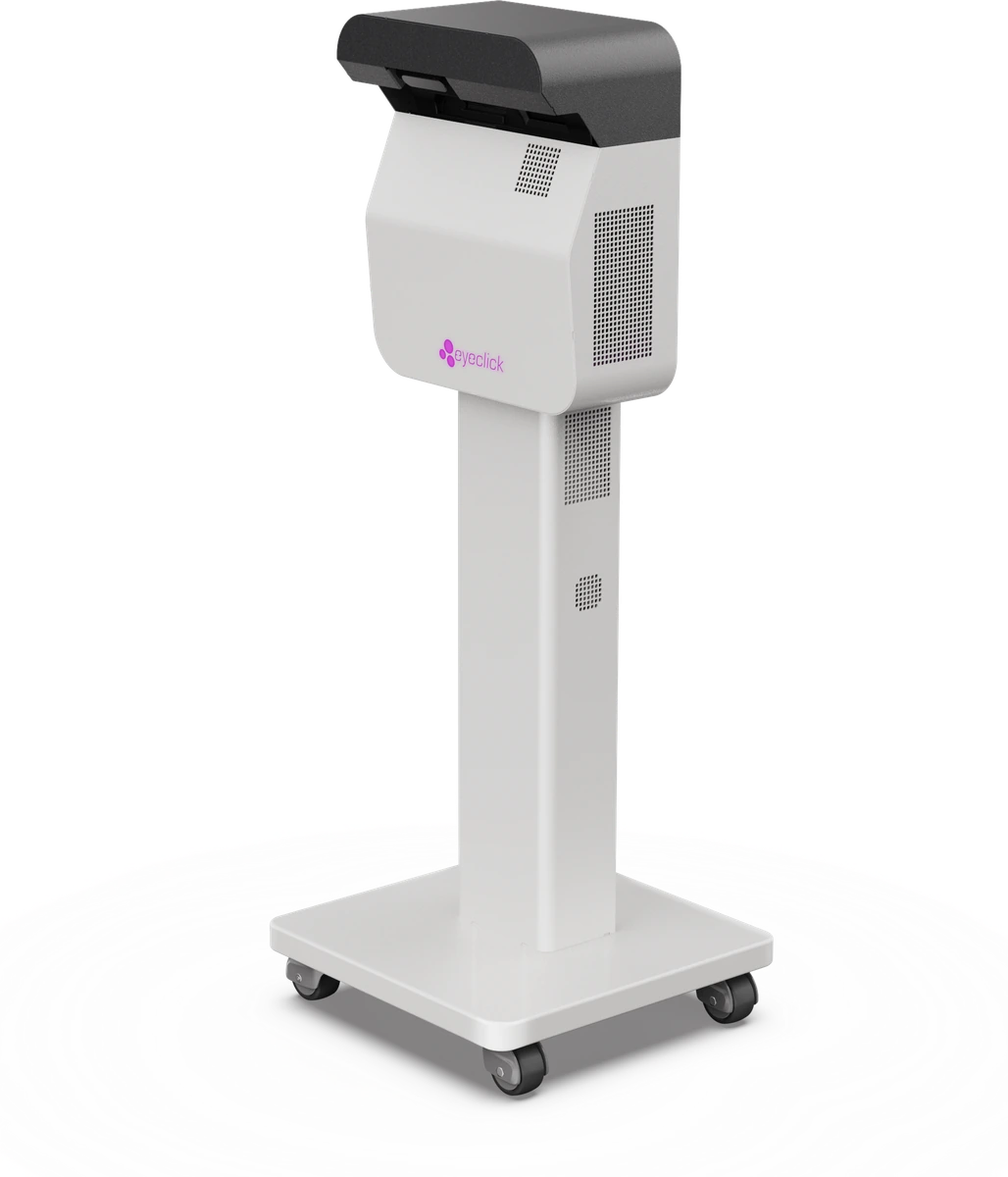
Built for a working clinic
The clinician controls the activity, difficulty, pace, and play-zone size. Patients interact naturally with projected targets instead of holding a controller or wearing a sensor.
Use a mobile configuration across treatment spaces.
Adjust speed, target size, pace, and challenge.
Choose floor, wall, or table activities based on the system.
Camera-based interaction with nothing to hold.
What clinicians use it for
The treating clinician chooses the activity and sets the demand for the patient in front of them. EyeClick does not prescribe treatment or replace clinical judgment.
Visible targets for controlled shifting, holding, reaching, and recovery.
Target patterns with clinician-set spacing and pace for movement practice.
Activities that combine movement with choosing, tracking, sorting, and reacting.
Seated or standing activities with adjustable duration, range, and intensity.
Real clinic workflow
Watch Dr. Mike Studer connect EyeClick activities to attention, inhibition, memory, agility and dual-task demands inside Re+Active Physical Therapy and Wellness.
Dr. Mike Studer is a paid consultant to EyeClick. This video shows real-world workflow at 1 clinic. It does not present results from a controlled clinical study or promise clinical outcomes, reimbursement or insurance coverage.
Mike Studer: I'm not working on balance, but I'm working on balance. Hi, my name is Mike Studer. I've been a physical therapist for 35 years, and I'm excited to introduce to you EyeClick.
Mike Studer: Now we're here at Re+Active Physical Therapy, a forward-thinking, advanced physical, occupational and speech therapy, as well as neuropsychology clinic here in El Segundo, California. EyeClick is fitting itself right in. We've got it out here on the floor. I'm going to show you the game library now, which is built largely on neuropsychological assessments, tests of agility and other gold-standard and very familiar tasks.
Mike Studer: With School of Fish, I could be selecting based on what's called the Flanker Test. With Meteor Defense, I'm working on Stroop Color Word. With Safe Crossing, I'm working on a different form of inhibition. With Choir, I'm working on Auditory Stroop. Listen to a low sound, select the high signal. With Real World Navigator, we're using everyday opportunities to memorize your seat, ticket, gate and luggage.
Mike Studer: This is called EyeClick. As you can see, it's projecting down onto the floor. We have a white mat to give us higher contrast. It's very low profile. It's easy and intuitive to operate. Using the remote and familiar icons, I can select whatever game I might want to play. The games are open for feedback, and you can make selections depending on what your patients need.
Mike Studer: The Flyswatter game is very nice for people who want to play and have a lot of agility. Think about this as your body is the joystick. Your agility, rather than your hands, is going to be the input. This gives your patients a degree of autonomy where they can lean in and challenge themselves, try to beat the score, or make it easier if it felt too difficult. There aren't many opportunities where the patient gets to select the dosage like this. Agility, thinking and alternating attention all come with an opportunity to move around the world. I'm not working on balance, but I'm working on balance.
Mike Studer: I'm here with the world champion, Pablo, and he's playing EyeClick today. He's going to play Meteor Defense at the level of difficulty he chooses while solving a Rubik's Cube. The cube is completely disorganized, and his therapist will attest that it is randomized. Pablo, the stage is yours.
Participant: I just start playing with those?
Mike Studer: He's got to grab all the red meteors while he's solving the Rubik's Cube. Now it's going to be blue meteors. Both at once. He noticed that the target changed to red meteors while he's solving the Rubik's Cube and moving. Intensity is required for neuroplasticity, and Pablo is a champion.
Mike Studer: Pablo demonstrated divided attention, mobility and thinking, but also alternating attention. Colors and Rubik's Cube, colors and Rubik's Cube, and the directions were changing. That was fabulous. I appreciate your personality and your drive. Good job.
Mike Studer: Would you like an opportunity to simulate travel and also do some therapy on your memory? This is going to be a virtual plane trip. I want you to memorize, just like you are traveling overseas, your gate, ticket, seat assignment and luggage.
Participant: Sure.
Mike Studer: Was this beneficial for you, or was this a waste of time?
Participant: Very beneficial. Very beneficial. It was more meaningful, I think. I killed it.
Mike Studer: You killed it. You made it safely to Paris and found your taxi. Good job, Craig. Thanks for playing along.
Mike Studer: The system type you have is a mobile unit, and it can be played easily on a desktop. Other system types are mounted on a ceiling. It can be played on a wall, desktop or floor. There is a collection of more than 80 games that are primarily desktop-based.
Mike Studer: For me, what I'm trying to contribute here, I'm not an employee of the company. I don't have any sales incentives whatsoever. I'm just a consultant. For your successful patient stories, even if you made zero changes to it, there is the opportunity for it to contribute to your therapy experiences.
EyeClick gives clinicians a flexible way to combine physical movement with attention, reaction, counting, sorting, or choice. The therapist remains in control of the task and progression.
Change target size, pace, duration, and projected area for the patient and session.
Patients see and hear a response to their movement as the activity unfolds.
Repeat an activity or progress the demand without rebuilding the room setup.
Visual and audio prompts can keep the movement goal clear and observable.
Choose the task, tune the challenge, then observe and adjust inside the session.
Choose from movement, reaction, reaching, endurance, or combined physical and cognitive activities.
Configure pace, target size, play-zone size, duration, and the surface used.
Observe the patient's response and adjust the task using your normal clinical judgment.
Systems start at $5,796. Final pricing depends on the model, configuration, number of rooms, and installation needs.
Best for clinics that want to share 1 system across multiple treatment rooms.
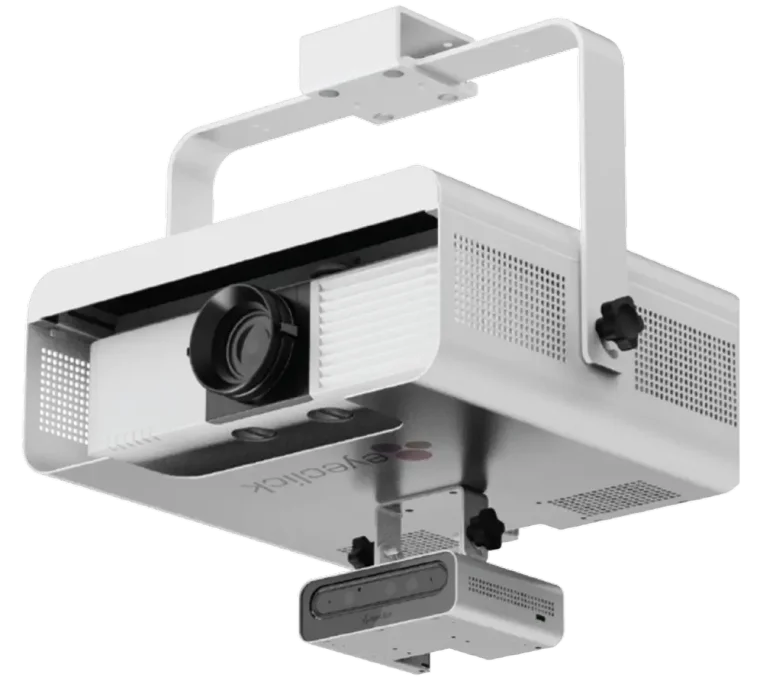
A compact configuration for a dedicated treatment area.
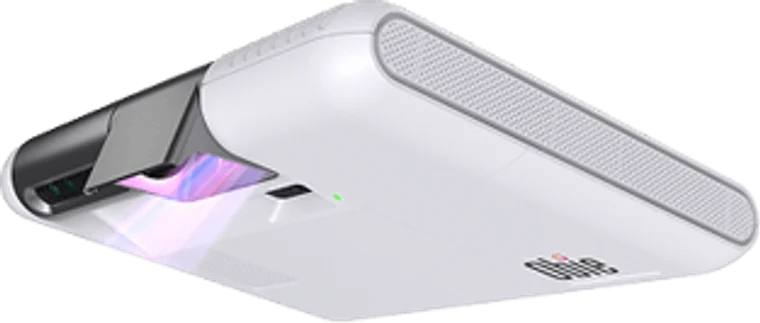
A ceiling-mounted interactive system for a dedicated clinic activity space.
EyeClick starts at $5,796 and is purchased by the clinic as equipment. Coverage and payment for PT or OT services depend on the service furnished, medical necessity, documentation, payer rules, and the clinic's contracts. EyeClick equipment is not represented as universally reimbursable. Equipment financing or Section 179 treatment may be available depending on lender approval, business eligibility, and tax circumstances. Review the full funding and reimbursement guide with your billing and tax advisors.
Clear answers about workflow, space, pricing, and how coverage relates to clinician-delivered services.
How does EyeClick fit with Medicare Advantage and supplemental coverage?
Can clinicians bill for sessions that use EyeClick?
Is the Re+Active video a clinical study?
Do patients have to wear or hold anything?
Can 1 system cover floor, wall, and table activities?
How much clinic space and setup time does it need?
How much does a system cost?
What content and services are included in a clinic package?
Can we start with 1 clinic before expanding?
Tell us about your treatment spaces, caseload, and planned use. We will recommend a configuration and send a formal quote.